The receiving system is missing
Great inventions, buyer demand, and deployment environments are often not organized into one path that others can understand and act on.

Arns designs the receiving system around breakthrough ideas — connecting research, IP, institutional capabilities, market demand, partners, teams, sponsors, capital, stakeholder experience, and deployment context into fundable, partnerable, venture-ready pathways.
Where the existing system breaks, how disconnected IP and capabilities become more valuable together, and what becomes possible when the deployment environment is designed correctly.
Great inventions, buyer demand, and deployment environments are often not organized into one path that others can understand and act on.
Universities, labs, companies, sponsors, and builders often only see one slice of the opportunity.
The path to licensing, venture creation, pilot design, sponsorship, partnership, or adoption is usually not designed as a full experience.
Promising capability remains underused because the surrounding commercial architecture never gets assembled.
Too much tech push, not enough structured market pull.
People, rights, partners, and resources are not lined up.
Potential licensing, ventures, pilots, and funding remain unrealized.
Start with the priority, bottleneck, white space, or unmet need worth designing around.
Identify the capabilities, technologies, partners, and constraints that become stronger when connected.
Shape how the opportunity becomes understandable, fundable, partnerable, buildable, and adoptable.
Coordinate who needs to move, how the story is framed, and what happens next.
Research, IP, and market pull become understandable to stakeholders who need to act.
Opportunities are shaped in ways that make it easier to support, endorse, or finance them.
Separate IP, technologies, ideas, institutions, and market needs can be recombined into stronger opportunity systems.
There is a more credible next step: licensing, partnership, pilot, venture, or deployment.
Capabilities and assets can be seen in context.
Real priorities shape the path from the start.
The route becomes something others can act on.
Clarify the portfolio, objective, white space, or opportunity area that deserves attention first.
Bring in the science, technologies, partners, teams, sponsors, and external complements that matter.
Organize the pathway into something partnerable, fundable, and executable.
Arns applies a repeatable process that moves from scattered inputs to structured opportunity systems. Each project improves the next by creating reusable category maps, partner routes, assessment criteria, intake structures, sponsor-facing formats, and deployment patterns.
Bring together market signals, university IP, lab capabilities, corporate priorities, infrastructure assets, rights pathways, technical constraints, and partner options that would normally sit apart.
Organize the opportunity around bottlenecks, required capabilities, commercial priorities, workflow fit, pilot environments, and the role each asset or stakeholder plays in the path.
Turn each opportunity into reusable intelligence: category maps, partner routing logic, intake criteria, market language, and commercialization patterns that increase the value of future work.
Move toward a clear next route: sponsor, license, pilot, build, partner, recruit, fund, deploy, redirect, or pause.
Some of the most valuable commercialization paths are not hidden inside a single patent, lab, company, or institution. They emerge when disconnected ideas are reassembled into a stronger system.
Arns identifies complementary IP, technologies, research capabilities, market signals, infrastructure needs, funding routes, and partner ecosystems across universities, labs, startups, corporations, and public-sector environments — then connects them into new commercialization architectures.
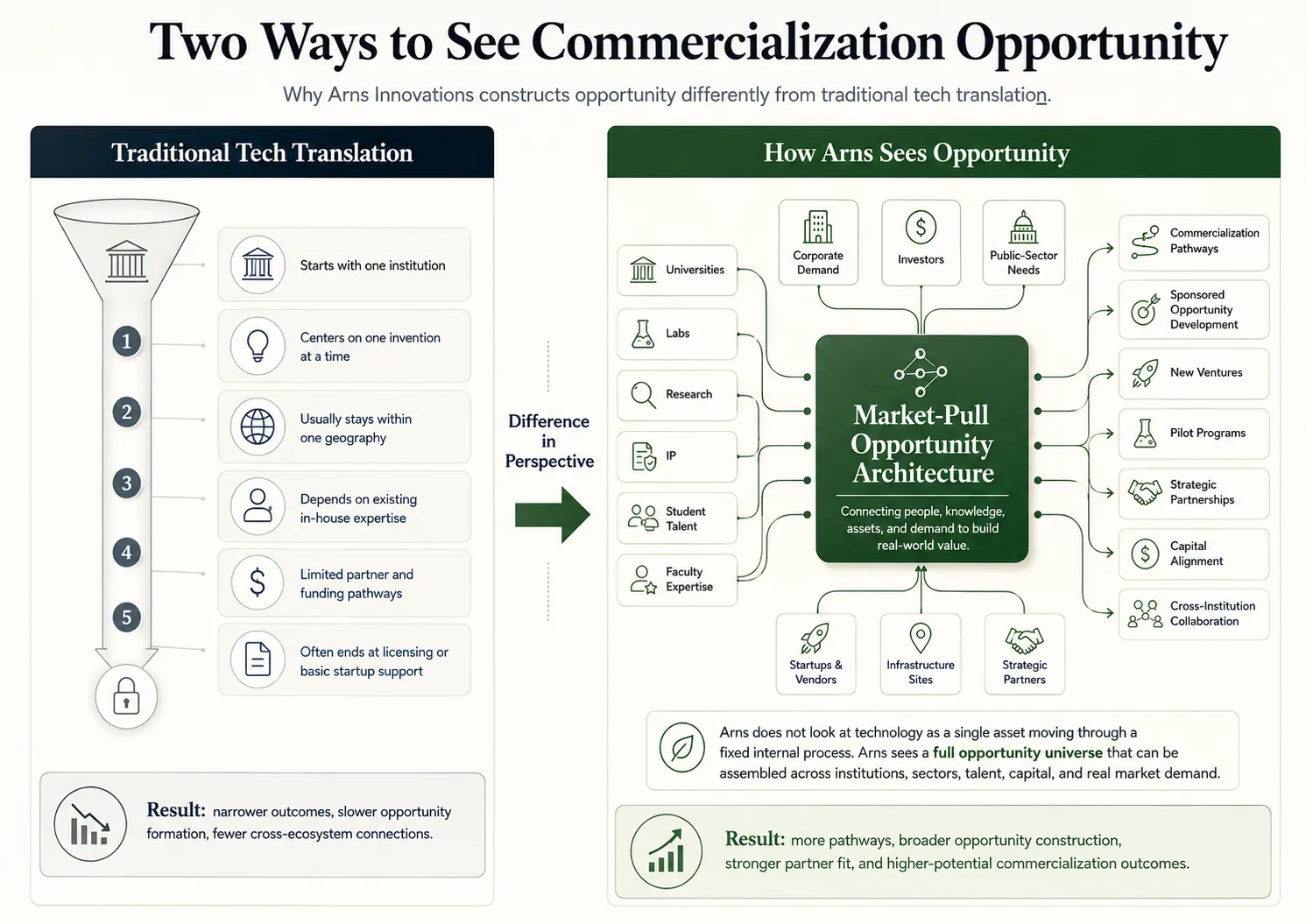
Arns does not simply identify promising technologies. It redesigns the system around them so they can become understood, desired, fundable, partnerable, and executable.
The model sits between technology transfer, venture building, corporate engagement, business development, investor readiness, team formation, public-private commercialization, and deployment strategy. Arns does not replace those functions. It creates the connective architecture that helps them coordinate around a specific opportunity.
The difference is not just bigger numbers. It is construction logic. Once opportunity is no longer confined to one institution, one geography, one technology portfolio, or one funding path, the number of viable routes expands dramatically because assets can be recombined around real demand.
| Dimension | Traditional Tech Translation Lens | Arns Opportunity Architecture Lens | Scale Signal | What This Proves |
|---|---|---|---|---|
| Institutional Scope | Usually begins inside one university, lab, or internal portfolio. | Looks across universities, colleges, labs, research centers, companies, and public-sector needs. | ≈21k–22k recognized higher-education institutions globally. | Arns is not bound to one campus, one geography, or one internal IP portfolio. |
| IP Universe | Usually starts with one disclosure, patent, or university-owned asset. | Searches across active IP, expired IP, national lab technologies, university portfolios, software, know-how, and complementary technologies that could form a stronger whole. | 3.7M patent applications filed worldwide in 2024. | The opportunity space is not one invention. It is a vast searchable IP landscape that can be recombined. |
| Builder Base | Students and founders often join only after a startup or program already exists. | Students, founders, operators, alumni, and future leaders can be matched into real opportunity pathways from the beginning. | 264M higher-education students globally. | The builder pool is massive if institutions can convert research into structured venture opportunities. |
| Pathway Design | Often moves toward licensing, startup support, or a single partner conversation. | Can create multiple outcomes: pilots, ventures, licenses, partnerships, sponsored opportunity development, investor pathways, and university programs. | Combinatorial, not fixed. | Possible pathways expand when IP, people, partners, capital, and market demand can be recombined. |
The result is not just a better idea. It is a more complete system for moving research, IP, market demand, partners, teams, and capital toward real-world execution.